Sound modeling
What I did
- Sound programming in Supercollider
- Spectrum analysis using Audacity
What I used


About the project
I’ve often heard of visual artists at IGAD being told by their teacher to gather references. I thought of trying something similar with sound while following a Supercollider course.
Spectrum analysis
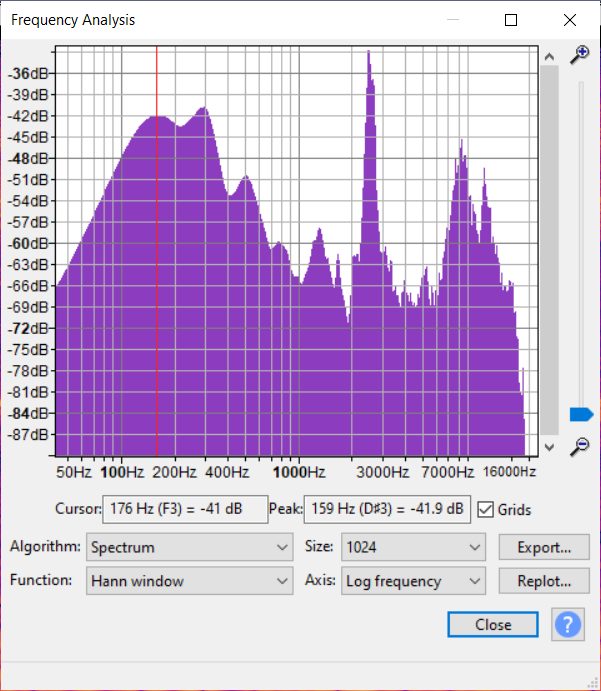
I used two main ways of analysing the reference, visual spectograms shown in the video, and also the following spectrum plot feature of Audacity..
Sound programming
The sound is generated using VarSaw, which can clearly be seen in the spectogram. The frequency of the VarSaw takes an LFNoise0 as input to not gradually modify the frequency but do so at clear intervals. The output of the VarSaw I assigned to a variable called pressure, as this is what I thought to be trying to model, the pressure that changes at a clear interval due to the flute ball “cycling”.
Then there is a SinOsc for the volume, for which I chose a sine to model the fluctuation of breathing into the whistle. This takes an LFNoise0 to also have some clear cut frequency changing, which I think was to immitate that every cycle of the whistle ball would probably keep the same pressure, thus changes are more likely to happen clear cut. I also modified the volume with some of the pressure (the var saw), to let that have an effect on loudness too.
For the tone I used a SinOsc which directly uses the pressure as input to lerp between min and max freqeuency. The min and max frequency I read from the spectogram shown in the video.
As background/ambient noise there I used PinkNoise multiplied by a SinOsc which I image is to blend it with the noise that is there as all sound blends together as the waves travel through the same air.
I used mouse input on the X axis to control the exact frequency range, and mouse input on the Y axis to control a lerp between the air and the tone. I moved the mouse around to try to find a nice balance and by printing the values to the console I then copied and hardcoded them to select ones I liked.
This project was mostly a fun experiment, and I make no claims about the objective accuracy of it. It was mostly trying to take a visual-art like “feeling” approach, but an informed one where possible (hence also the reference).